

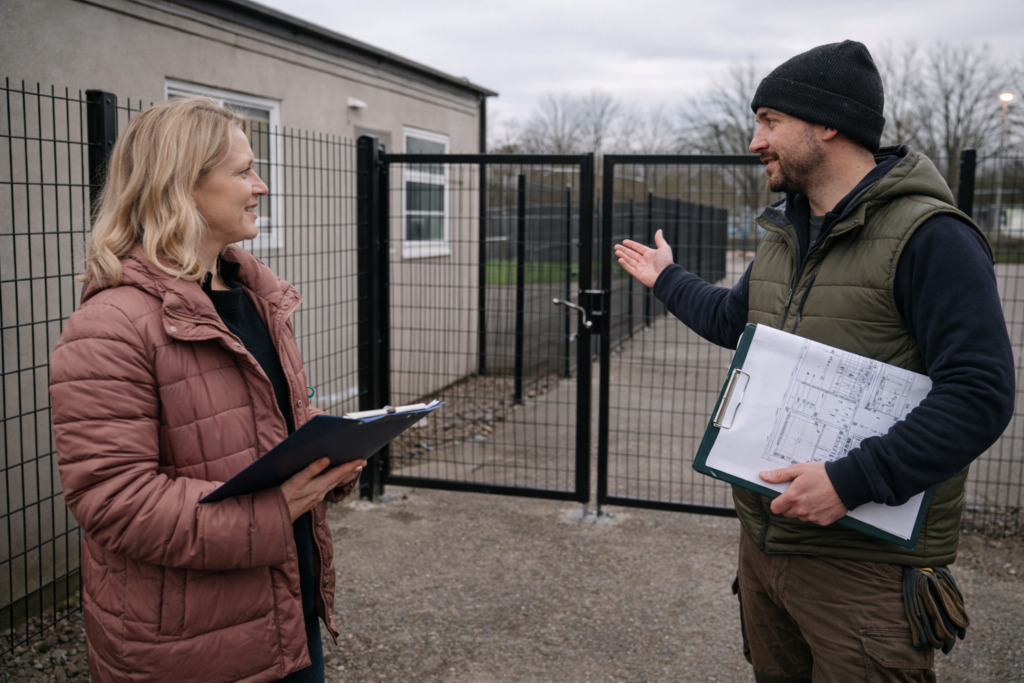
Choosing security fencing for a commercial site is not just about picking the strongest-looking option. The right fence needs to suit how your premises operate day to day, where access is required, and what level of risk you are realistically trying to manage. Get it right and your site becomes harder to access, easier to monitor, and simpler to manage. Get it wrong and you can end up with weak points, frustrated staff, or a fence that looks out of place.
This guide explains how businesses in York can choose security fencing that actually works, without overspending or creating unnecessary complications. If you want tailored advice for your site, our security fencing in York service can help you specify a system that fits your layout, risk level, and budget.
Start with how your site is actually used
Before looking at fence types, it helps to step back and think about how your premises function. A warehouse, a small office unit, a school, and a managed residential block all have very different needs, even if they sit next door to each other.
Key questions to ask include:
- Where do people enter and exit the site each day?
- Which areas need to be secured out of hours?
- Are there delivery zones, yards, or storage areas?
- Do staff, visitors, or residents need controlled access?
- Are there areas that should remain visible for safety or monitoring?
Security fencing should support how the site works, not fight against it. A fence that blocks visibility or restricts movement in the wrong place can create operational problems rather than solving them.
Assess the level of risk realistically
Not every commercial site faces the same level of risk. Over-specifying fencing can waste money, while under-specifying can leave obvious weaknesses. The aim is to match the fence to the likely threats, not the worst-case scenario.
Lower risk sites may include:
- Office buildings with limited external assets
- Sites in visible, well-lit areas
- Premises with low foot traffic out of hours
Higher risk sites often include:
- Industrial units and warehouses
- Storage yards and compounds
- Schools and managed facilities
- Sites with rear access routes or secluded boundaries
Understanding where your site sits on this scale helps narrow down suitable fencing options without jumping straight to the most aggressive-looking system.
Common security fencing options for businesses
Commercial security fencing comes in several forms, each with strengths depending on layout, appearance, and risk profile.
Welded mesh fencing
Mesh fencing is one of the most popular choices for commercial premises because it balances strength, visibility, and appearance. It allows staff, neighbours, and CCTV systems to see through the boundary, which increases natural surveillance and reduces hidden areas.
Mesh fencing can be specified with different wire thicknesses and aperture sizes. Tighter mesh reduces footholds and makes climbing more difficult, while still keeping the site visually open.
Palisade fencing
Palisade fencing is typically chosen where deterrence needs to be very clear. It creates a strong visual boundary and can be difficult to climb. This type of fencing suits industrial areas, yards, and sites where appearance is less critical than perimeter strength.
For many businesses, palisade is most effective when used selectively, for example around rear boundaries or storage areas, rather than along public-facing frontages.
Railings for commercial frontages
Where a professional appearance matters, railings can provide security without making the site feel closed off. They work well for schools, offices, and customer-facing premises where you want a clear boundary that still looks appropriate from the street.
Like mesh, railings maintain visibility, which supports monitoring and discourages unwanted behaviour.
Why gates and access points matter most
One of the biggest mistakes businesses make is focusing on fence panels while overlooking gates and access routes. A strong fence with a weak gate is not secure. Gates need to be correctly positioned, properly hung, and fitted with hardware that suits how they will be used.
Common access point issues include:
- Gates that are too narrow or awkward for deliveries
- Gate posts that are not strong enough for regular use
- Hardware that loosens over time
- Too many access points creating unnecessary weak spots
A good perimeter design often reduces the number of access points and makes the remaining ones easier to control.
Visibility and monitoring should guide fence layout
Visibility plays a major role in deterrence. Commercial sites that allow clear sight lines along boundaries are easier to monitor, both informally and with cameras. This is one reason mesh and railings are so widely used on business premises.
When planning security fencing, it is worth considering:
- How the fence line interacts with existing CCTV
- Whether lighting covers key boundary sections
- Where blind spots might occur
- How vegetation could affect visibility over time
Good fencing works with lighting and monitoring, not against it.
Planning and site considerations in York
Some commercial sites have additional considerations, particularly in built-up or mixed-use areas. Fence height, appearance, and placement can all be factors depending on location and neighbouring properties.
While many security fencing installations do not require planning permission, it is always sensible to consider the context early. A fence that looks appropriate for the area is less likely to cause issues later.
Balancing security, appearance, and budget
For most businesses, the best solution is not the cheapest or the most extreme. It is the one that provides reliable security, fits the site visually, and stays within budget without creating future problems.
A sensible approach often involves:
- Using stronger fencing in higher risk areas
- Choosing cleaner, more visible fencing for frontages
- Specifying gates properly rather than as an afterthought
- Installing posts and fixings correctly to avoid early failure
This kind of balanced specification usually delivers better long-term value than cutting corners or overbuilding unnecessarily.
How we help businesses choose the right fencing
When we work with commercial clients in York, we start by understanding how the site operates and where the real risks are. From there, we recommend fencing systems that suit the layout, usage, and environment, rather than pushing a one-size-fits-all solution.
We look at access points, visibility, ground conditions, and how the fence will perform over time. The result is a perimeter that feels considered, secure, and practical.
If you are planning security fencing for a commercial site, visit our security fencing in York page to learn more or arrange a site visit.