

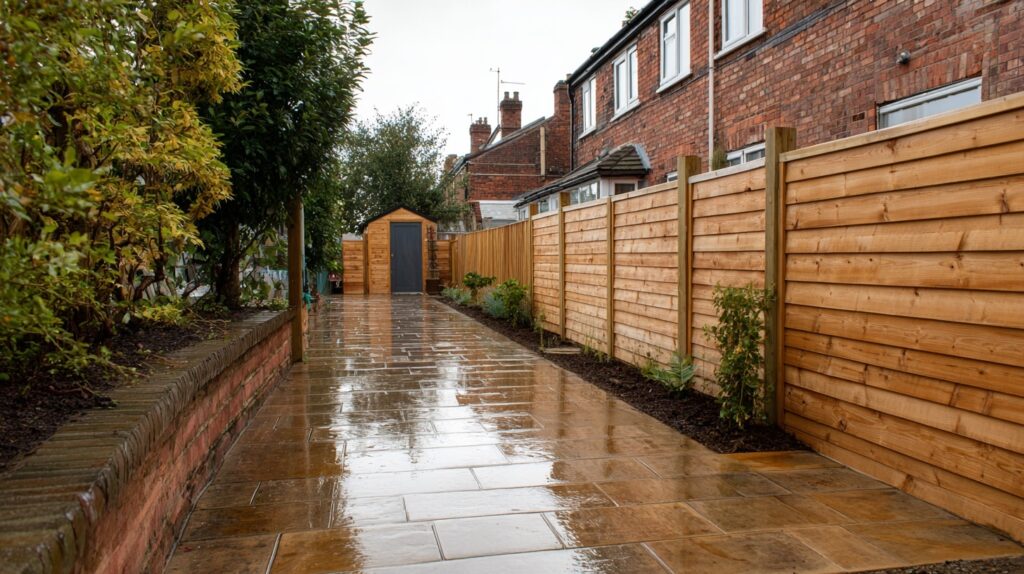
If you live in York and you are weighing up composite fencing against traditional timber, you are not alone. I have spent years pulling out rotten panels in Acomb, replacing storm blown fences in Rawcliffe and fitting modern composite runs around new builds in Haxby and Huntington. I can tell you straight – both composite and timber can be excellent options in the right garden, but they are very different beasts.
This guide walks you through how each performs in real York conditions – the rain, the wind, the clay soil and the mix of heritage terraces and new estates – so you can decide what will serve you best in your own garden.
What do we actually mean by composite and timber fencing?
Timber fencing is what most people in York still have. Closeboard (featheredge) on timber or concrete posts, standard panel fencing in between existing posts, or a mix of older lap panels and newer replacements. It is made from treated softwood and, when installed properly, it is strong, smart and relatively cost effective.
Composite fencing is built from boards made using a blend of plastics and recycled wood fibres. The boards slot into matching posts or rails to create a very uniform, modern looking fence. You will see a lot of composite around newer housing estates and in gardens where people have gone for porcelain patios, bi fold doors and low maintenance planting.
At York Fencing, we install both. The right choice depends on your garden, your budget and how much maintenance you are prepared to do over the next ten to twenty years.
How each fence handles York’s weather
Timber fencing in a damp, windy city
York is not gentle on fences. We get plenty of rain, we have pockets of very heavy clay, and we are not strangers to strong winds coming across open fields around places like Poppleton, Strensall and Wheldrake. Timber can handle this, but only if it is installed with the right spec and cared for sensibly.
Pressure treated timber closeboard on decent posts with gravel boards will usually give you many good years of service. Where I see problems is with old, lightweight lap panels sat straight on soil, or posts set too shallow in soft ground. Once rot gets into the base of timber posts, or panels start to bow, the whole line becomes vulnerable when the next winter storm rolls through.
Composite fencing in York conditions
Composite boards are far less bothered by damp. They do not absorb water in the same way as softwood, so they do not swell and shrink with every wet and dry spell. They also do not rot. That makes them a strong contender in shaded gardens in Fulford, Heslington or tangles of mature planting in older parts of the city where timber can stay damp for months at a time.
In wind, the performance is more about the posts and the installation than the boards themselves. A composite fence on properly set composite or concrete posts with decent concrete footings will stand up very well. If you live on an exposed corner plot, I treat the design almost like I would a robust closeboard run – generous post spacing, correct depth, and attention to wind loading.
Durability and lifespan – how long will your fence actually last?
Timber lifespan in the real world
A lot of people ask me, “How long will a timber fence last?” The honest answer is that it depends on three things: the quality of the timber, how it is installed and how you look after it.
With pressure treated timber, concrete posts and gravel boards, you can reasonably expect a properly installed garden fence in York to last well into double figures in terms of years. I regularly see good closeboard still performing after fifteen or more years when it has been sensibly maintained and not choked with ivy or buried in soil.
On the other hand, I also get called to replace flimsy lap panels that have only managed five or six years before blowing out or rotting at the base. The lesson is simple – the spec you choose makes a massive difference.
Composite lifespan and guarantees
Most composite systems are designed with a lifespan of twenty years plus, and quite a few come with manufacturer warranties to match. Because the boards do not rot and do not split in the same way softwood does, you are not battling constant deterioration.
What can shorten the life of a composite fence is poor installation – shallow posts, undersized footings or the wrong fixings. Get the structure right and composite will usually outlast equivalent timber, especially in wet or shaded plots.
Maintenance – how much time do you want to spend looking after your fence?
Looking after timber fencing
Timber fences are a bit like cars – they will treat you as well as you treat them. If you never clean, protect or check them, they will age fast. If you keep an eye on them, they will last far longer and look better doing it.
With timber, you should expect to:
- Brush off algae and dirt every year or two
- Apply a decent quality stain or preservative every few years
- Keep plants, ivy and soil away from direct contact with the boards
- Check for loose nails, split boards or wobbling posts after strong winds
None of that is complicated, but it does take some time and effort. If you enjoy pottering in the garden and you like the idea of choosing colours and stains, timber gives you flexibility.
Maintaining composite fencing
Composite is as close to “fit and forget” as you get with fencing. You will still need to give it a wash now and then to remove surface dirt, algae and bird mess, but you will not be painting or staining it. There is no need for preservatives, and the colour is built into the board.
For a lot of busy households in York, that low maintenance side is the main reason they choose composite. It is particularly appealing for rental properties and second homes where you do not want to be dealing with timber upkeep every few years.
Appearance and style – what will actually suit your York garden?
Where timber still wins
There is a reason timber has been the default choice for so long. It is warm, it is natural and it sits well against brick, stone and planting. In older areas of York, such as the Groves, Clementhorpe or the streets off Bishopthorpe Road, a good timber closeboard fence often looks more in keeping than a very modern composite system.
Timber is also easy to customise. You can add trellis, shape the tops, paint it soft grey to match your windows or stain it to echo the colour of your decking. As your garden evolves, you can change the look of the fence with a new coat of stain or paint.
The look of composite fencing
Composite really comes into its own in modern gardens. Paired with porcelain patios, anthracite windows and bi fold doors, it gives a clean, contemporary backdrop. The colour is usually very even, the lines are crisp, and there is none of the variation you get with natural timber.
If you are in a new estate in Haxby, Huntington, Clifton Moor or around the ring road and you want a low maintenance, modern finish, composite is hard to beat visually. You do need to like that uniform, engineered look though – if you want rustic character, timber will probably still appeal more.
Cost – upfront price versus long term value
Initial installation costs
As a rule of thumb, timber fencing costs less upfront than composite. A properly specified timber closeboard fence with concrete posts and gravel boards is not cheap, but a like for like run in composite will usually come in higher on material cost.
If you are working to a tight budget and you need to get a long run replaced quickly, timber often makes more sense. We can still specify it in a way that gives you strong, long term performance without going overboard.
Lifetime cost and value
Where composite starts to look stronger is when you look at total cost over ten to twenty years. With timber, you need to factor in:
- Cost of stains or paints every few years
- Time or labour for that maintenance
- Occasional board, panel or post replacements as things age
With composite, almost all of that disappears. Once it is up, you are mainly just washing it down. If you plan to be in the same property for a long time and you want a fence you do not have to think about, the extra initial spend on composite can pay for itself slowly over the years.
Environmental considerations – which is greener?
Timber as a natural material
On the face of it, timber feels like the obvious “green” option. It is a natural material, it can be sourced from responsibly managed forests, and it can be recycled or repurposed more easily than plastic heavy products. The flip side is that timber fences do not last forever, and repeated replacements mean more resources used over time.
Composite and recycled content
Composite boards are made using recycled plastics and wood fibres, which is a positive, but they are still tied to plastic production and they are more complex to recycle at the end of their life. Where composite scores from an environmental point of view is durability – if one composite fence saves you from needing two or three timber replacements over several decades, that can still be a win.
As with most things, the greenest option is one that is installed properly, lasts as long as possible and is not replaced unnecessarily. That is where good design and specification matter more than the label on the material.
Typical scenarios – which works best where?
Scenario 1: Traditional terrace in Holgate or South Bank
Small to medium back garden, brick outhouses, older paving and plenty of character. Here, a timber closeboard fence on concrete posts usually looks and feels right. You get privacy, strength and a natural backdrop for planting without things feeling too clinical.
Scenario 2: New build in Haxby, Huntington or Clifton Moor
Modern kitchen doors, clean lines, low maintenance planting. Composite fits this sort of space perfectly. Once it is up, you can forget about staining and you have a smart, consistent boundary that ties in with the rest of the house.
Scenario 3: Exposed corner plot in Rawcliffe or Strensall
Lots of wind, open fields one side, and the last fence blew down. In these gardens, the priority is structural strength. I would normally lean towards heavy duty closeboard with concrete posts and gravel boards, or a carefully specified composite system with very solid posts and footings. The decision between timber and composite here is less about look and more about budget and maintenance preference.
Scenario 4: Shaded, damp garden near mature trees
If your fence line runs under large trees or along the bottom of a shady bank where things never quite dry out, composite has a real advantage. It will not rot, and you will not be constantly fighting green growth soaking into softwood. If you prefer timber, we can still design something robust – but I will be honest with you about the extra maintenance it will need.
Common questions I hear from York homeowners
Is composite fencing really maintenance free?
No fence is truly maintenance free, but composite comes close. You will still want to wash it down once or twice a year, particularly on the north facing sides where algae can build up, but you will not be painting or staining it. Compare that with timber, where a bit of periodic care is part of the deal.
Will composite look “plasticky” in my garden?
Older composite products could look quite artificial. The newer systems we install are much better in terms of texture and colour. They still look more engineered than timber, but in the right setting they look very smart rather than plastic. If we come out to quote, I am happy to talk you through samples so you can see them against your brickwork and paving.
Will a timber fence give me better privacy than composite?
In practice, both can give you full privacy. A solid timber closeboard fence and a solid composite panel system both create complete screening. The difference sits in the look, the maintenance and the cost, not in how much of your garden they hide from view.
How York Fencing can help you choose
Online guides are useful, but nothing beats seeing how things will work in your actual garden. When you ask us for a quote, we do more than measure up and fire over a number. We look at:
- How exposed your plot is to wind and weather
- How damp or shaded the fence line is
- What your neighbours have on the other side
- The style of your house and any existing landscaping
- Your budget and how long you expect to stay in the property
From there, we can talk through both composite and timber options, explain the pros and cons honestly, and give you clear, fixed prices for each approach. That way you are choosing with full information, not guesswork.
If you want to read more about how we install and replace fences locally, have a look at our main garden fencing service page, or browse other options on the services overview page.
So, composite or timber – what is best for your York garden?
If you like a natural look, you are comfortable doing the odd bit of maintenance and you want to keep your initial spend sensible, a well specified timber closeboard fence is still an excellent choice for most York gardens. Get the posts and gravel boards right and it will serve you well for many years.
If you want a modern, very low maintenance fence that you can almost forget about once it is up, and you are happy to invest a bit more upfront, composite is well worth serious consideration. In newer estates, shaded plots and busy households, it often makes perfect sense.
The best way to decide is to see what each option looks like against your own garden and hear what it will cost in clear terms.
Ready to talk through your options?
If you are torn between composite and timber fencing and you live in York or the surrounding villages, let us make the choice easier. We will visit, measure up, look at how your garden behaves in real weather, and give you honest advice based on years of fitting both types of fence locally.
Tell us your postcode, a rough fence length and whether you are leaning towards composite, timber or a mix, and we will do the rest.
Get in touch with York Fencing today to book a no obligation survey and a clear, fixed price for a fence that actually suits your garden and the way you live.