

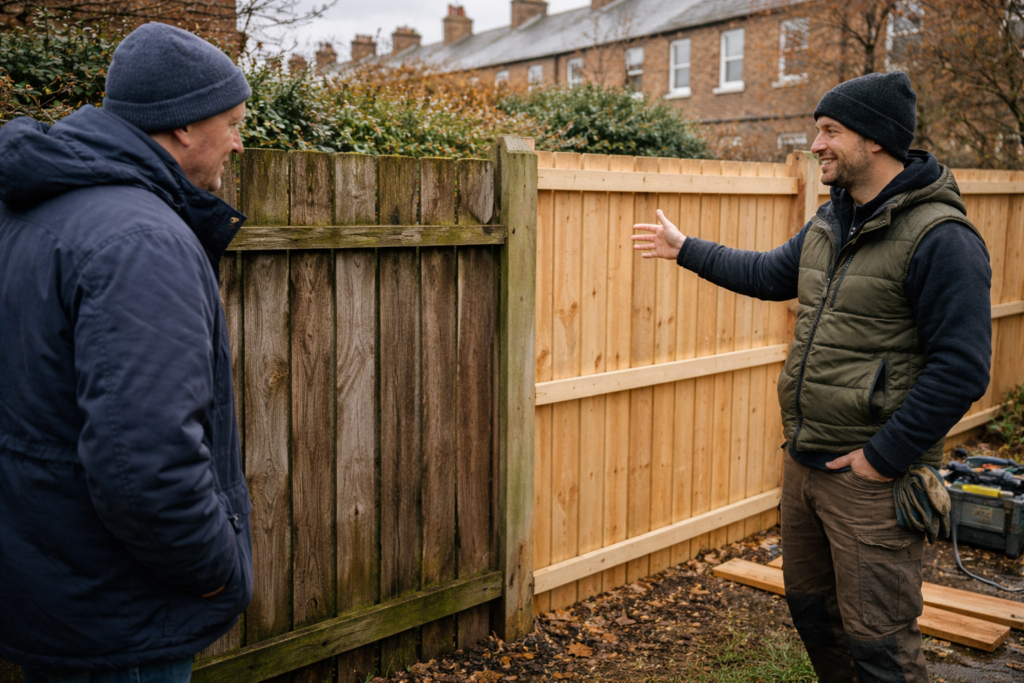
If your fence is leaning, rattling in the wind, or starting to look a bit worse for wear, the big question is usually the same – should you repair it, or is it time to replace it properly. It is a fair question, because a quick repair can be brilliant in the right situation, and a false economy in the wrong one. This guide will help you decide with confidence, using simple checks and real-world examples. If you want an expert opinion on your specific fence line, our fence repairs in York service can assess the damage and recommend the most sensible route.
We see plenty of fences in York that only need a tidy, targeted fix – a panel swap, a rail replacement, a post tightened up, or a gate adjusted back into line. We also see fences that have been patched repeatedly, where the posts are gradually failing and every “cheap fix” becomes another round of work six months later. The goal is not to spend the least today. The goal is to spend sensibly once and have a boundary you can rely on.
Start with the one thing that matters most the posts
Fence panels get all the attention because they are visible, but posts are what do the heavy lifting. If the posts are solid, a repair is often straightforward. If the posts are moving, leaning, or rotten at ground level, replacement starts to look more realistic.
Here are quick checks you can do safely:
- Push test: Gently push a post near the base. Any movement suggests the footing is loose or the post has degraded.
- Visual line: Stand back and look along the fence run. If multiple posts lean the same way, the whole line may be shifting.
- Ground level rot: Timber often fails where it meets damp ground. Probe gently with a screwdriver if the timber looks soft.
- Cracked concrete: If you can see concrete around the post, look for crumbling or splitting.
If your fence posts are stable and upright, repairing damaged panels or rails can be a smart, cost-effective option. If several posts are failing, you may end up replacing large sections anyway.
When a fence repair makes the most sense
Repairs are ideal when the problem is isolated and the underlying structure is still strong. In these cases, a well-done repair can add years of life and keep your boundary looking tidy without the cost of a full new fence line.
Repair is usually the best route when:
- One or two panels are broken but the posts remain solid and aligned.
- Rails have come loose or fixings have failed, but the timber is still sound.
- A single post has shifted and can be reset or replaced without rebuilding the full run.
- A gate is sagging or catching and needs hinge or latch adjustment.
- The fence is relatively new and the failure is clearly localised.
In York gardens, we often see panels fail first after high winds, while the posts remain fine. In that scenario, replacing panels and upgrading fixings can restore the fence quickly, and it is often the most sensible use of budget.
When replacement is the smarter long-term choice
Replacement is not always about wanting something new. Often it is the most cost-effective way to restore strength and avoid repeat repairs. If a fence is tired across the run, patching it can become an ongoing expense, especially when the posts are approaching the end of their life.
Replacement becomes the better option when:
- Several posts are rotten, loose, or leaning across the same fence line.
- Multiple panels have failed and the remaining panels are heavily weathered.
- The fence has been repaired several times and still feels unstable.
- The timber is splitting, warping, or soft in multiple places.
- You want to change the height, layout, or style for privacy or security.
- The boundary is critical for pets, safety, or securing access routes.
A fence that has “had its day” often shows a pattern – one repair triggers the next. If you fix the panel, the post moves. If you fix the post, the next panel fails. A new run with correctly installed posts and quality fixings resets the whole boundary and usually saves money over time.
The hidden cost of repeated patch repairs
One reason people get stuck in repair loops is that the first repair looks cheap, and it often is. But the second and third repairs arrive quickly if the structure is failing. The total spend over 12 to 18 months can creep close to the cost of replacing the affected run, without ever achieving the same stability or finish.
As a simple way to think about it:
- One-off repair: Great value when the structure is sound and the damage is local.
- Recurring repairs: Often a sign that posts or footings are failing and replacement may be better.
If you have already repaired the same fence line more than once recently, it is worth getting a proper assessment so you are not paying twice.
What affects the cost of repair or replacement
Costs vary, and the reason is simple – fences fail in different ways, and every garden has its own practical challenges. Rather than guessing, it helps to understand what actually drives pricing so you can compare quotes properly.
Common cost factors include:
- Length of the affected run: A single panel repair is very different to multiple bays.
- Number of posts involved: Post work takes more time and affects stability.
- Ground conditions: Hard ground, tree roots, and waterlogged soil can change the approach.
- Access: Tight side passages and limited access can increase labour and disposal time.
- Removal and disposal: Taking away old panels and posts can be part of the job.
- Materials and specification: Different styles and finishes have different costs and lifespans.
- Gates and hardware: Hinges, latches, and posts need to be aligned and secure.
When you compare quotes, make sure the specification is clear. A cheaper quote can sometimes mean shallower posts, lighter fixings, or a repair approach that does not address the underlying issue.
How to choose based on what you want the fence to do
It is not just about whether the fence can be repaired. It is also about what you need from that boundary. A fence that is “good enough” for a quiet garden might not be good enough if it secures a side access route, keeps a dog in, or protects a rental property between tenants.
Ask yourself:
- Do I need better privacy than the current fence provides?
- Is security a priority – especially at the rear or side access?
- Do I want the fence to look significantly better for kerb appeal or property presentation?
- Will this boundary need to cope with heavy weather exposure in the same spot?
If you are planning a wider garden upgrade, replacement may be the better route because it lets you choose a style that suits your space. If you are simply restoring a fence that still fits your needs, repair can be ideal.
Common fence scenarios we see in York
Every property is different, but a few patterns appear again and again across York and surrounding areas.
- Panel blown out after wind: Posts sound – replace panel, upgrade fixings, check alignment.
- Leaning run with soft posts: Posts failing – replacement of posts and sections often best.
- Gate sagging and dragging: Often repairable – hinges, latch, and post alignment.
- Old fence patched for years: Time for a fresh start – replacement avoids repeat repairs.
The best approach is always based on the underlying structure. A neat-looking panel repair will not last if it is attached to a post that is ready to move again.
How we approach fence repairs and honest recommendations
When we assess a fence, we are looking for the simplest solution that gives you a stable result. Sometimes that means a straightforward repair. Sometimes it means being honest that replacement will save money and hassle over the next couple of years.
Typically, we will:
- Check post stability and footing condition along the run
- Identify what failed first and why
- Recommend repair if the structure is sound
- Recommend replacement where repeated repairs are likely
- Provide a clear quote so you understand what is included
If you would like a professional opinion, our fence repairs in York service can help you decide whether a repair will genuinely last or whether a replacement section is the better investment.
Frequently asked questions
How do I know if my fence posts are still good
If posts are upright, do not move at the base, and show no signs of rot at ground level, they are often suitable for a repair. If there is movement or softness near the base, the post may be failing.
Is it cheaper to repair a fence than replace it
Usually yes, if the damage is isolated and the structure is sound. If multiple posts are failing or you have repeated issues along the same run, replacement can be better value over time.
Can I replace just part of a fence
Yes. In many cases, replacing the worst section and tying it neatly into the existing fence line can be a sensible compromise, especially if the rest of the run is still stable.
Will a repair look like a patch
A good repair should look tidy and intentional. Matching materials helps, but the key is correct alignment, secure fixings, and a clean finish. If the existing fence is heavily weathered, a repair may stand out slightly, which can be a sign that replacement will look more consistent.
Get advice on fence repair or replacement in York
If you want the most sensible option for your fence, it starts with an honest assessment of the posts and structure. We can advise on repair, partial replacement, or a full new run depending on what will give you a stable boundary.
Need help deciding? Visit our fence repairs in York page and get in touch to arrange a site visit and quotation.